
Custom Entities vs Non-Fixed Intervals
Decide whether to use a Custom Entity (CE) or a non-fixed interval for repeating data.
Role required: Project Management
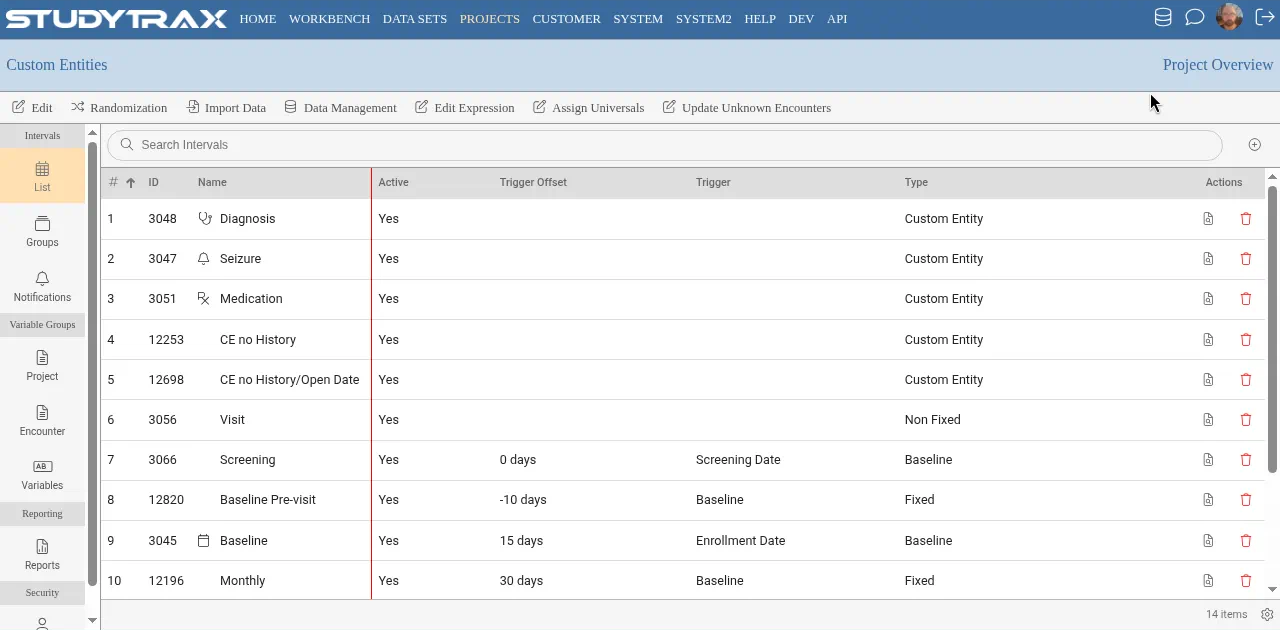
Decision questions
Ask these questions to choose the right structure:
| Question | If yes → |
|---|---|
| Is the data tied to a specific visit? | Non-fixed interval |
| Does it need a follow-up schedule (e.g., SAE with 30-day check)? | Custom Entity |
| Will you reconcile it at visits? | Custom Entity |
| Is it entered at one visit and closed at another? | Custom Entity |
| Are different people entering vs reviewing? | Custom Entity |
| Does it happen during visits or between visits? | During → non-fixed; Between → CE |
| Do you need data to move forward / track history over time? | Custom Entity |
Rule of thumb: If the visit drives follow-up, use a Custom Entity. If standalone, use a non-fixed interval.
Typical Custom Entities
Under the follow-up structure, these are commonly implemented as CEs:
- Medications
- Seizures
- Diagnoses / conditions
Other repeated data (clinic visits, ad-hoc surveys) are typically non-fixed intervals.
Custom Entity dates
A CE has an open date (start) and a close date (end).
Important: The close date and open date cannot be the same day—dates are not inclusive.
Pattern for same-day close: If you need to close a CE on the same day it was opened, use a hidden close-date variable that adds one day. Do not display this derived date to users.
Using intersected encounter date
When no variable is designated as the open date and Track History is off, you can use the intersected encounter date instead. This lets the CE inherit its date from the encounter where it's reviewed.
Related
- Intervals in depth — trigger events, encounter count, scheduling
- Create an interval — basic interval setup
- Data model — how CEs fit the data hierarchy